URBAN FORESTRY STUDIO

We worked in collaboration with the City of Syracuse Urban Forestry department during this studio to generate new ideas for how the City of Syracuse can continue to optimize and uplevel their urban forestry goals and practices.
PROPOSED CONDITIONS
FALL
2024
Added elements include: increased tree plantings to grow tree canopy, curb cuts with bioretention planted with grassy salt loving basins to catch pollutants and absorb winter salt slurry, colorful mural crosswalks, city incentives for renters/homeowners to plant perennial flower and bulb plantings for homeowners and regular neighborhood cleanups for streets, sidewalks and homes.

EXISTING CONDITIONS
In general, the City of Syracuse is working hard to optimize and grow their urban tree canopy. They worked with MLA students in their design studio at SUNY ESF during the Fall of 2024 to generate new ideas and fresh concepts for how they might continue to uplevel their urban forestry tactics and actionable outputs.
DATE
FALL 2024
PROJECT LOCATION
ASSORTED URBAN FORESTRY PROJECT SITES
NEIGHBORHOODS THROUGHOUT SYRACUSE, NEW YORK
PROGRAMS + TOOLS USED
HAND DRAWING, PENCIL, COLORED PENCIL, PEN, CAD-MAPPER, HISTORICAL ARCHIVE RESEARCH, DIGITAL CAMERA, ILLUSTRATOR, PHOTOSHOP, INDESIGN
LEARNING OUTCOMES
WE WORKED WITH THE CITY OF SYRACUSE URBAN FORESTRY TEAM WITHIN THE PARKS AND RECREATION DEPARTMENT TO DEVELOP STRATEGIES AND ACTIONS TOWARDS INCREASING AND MAINTAINING THE URBAN FOREST CANOPY IN SYRACUSE, NEW YORK TO ACHIEVE NEW GOALS IN SUSTAINABILTY, GREEN INFRASTRUCTURE, PUBLIC AND SOCIAL HEALTH AND STORM WATER MANAGEMENT.
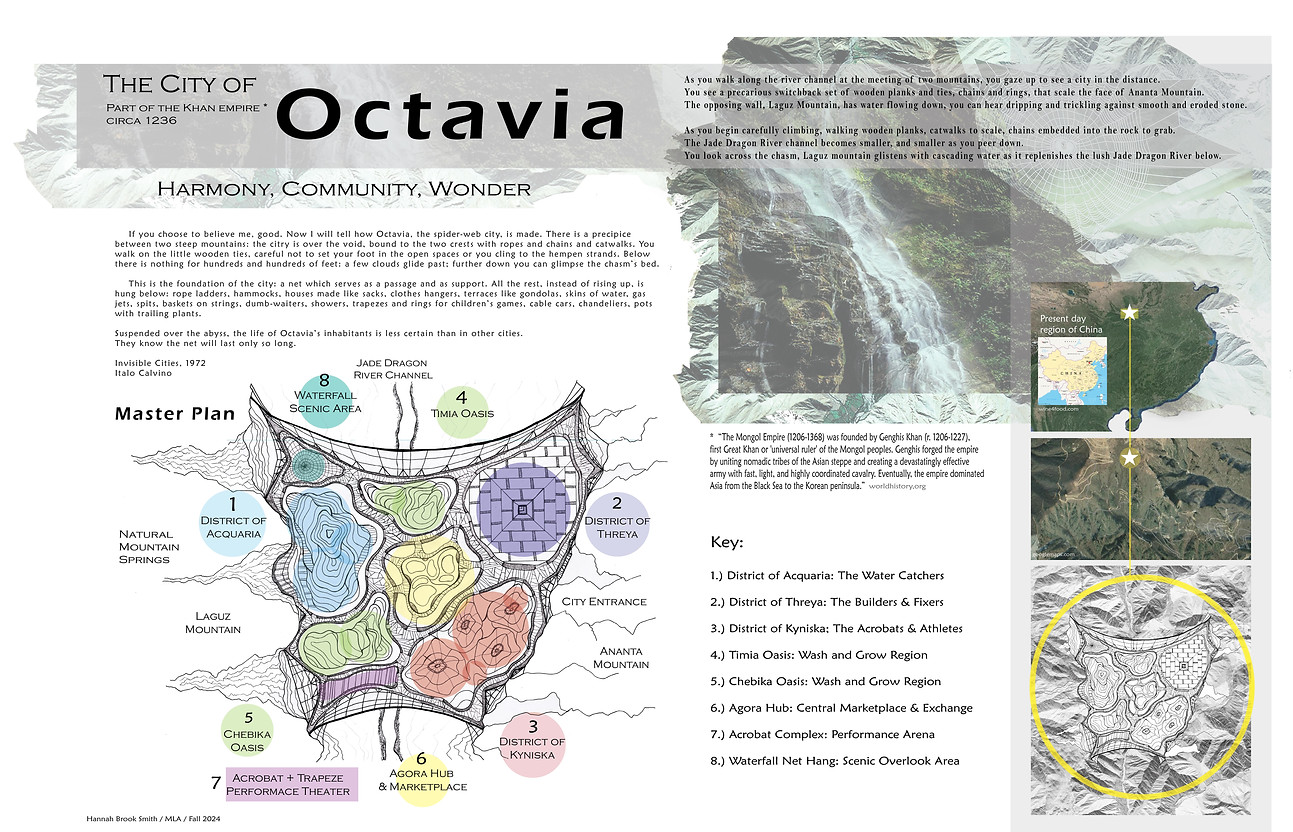
Design Prompt 01 | Invisible Cities; Design an Imaginary City
Our first prompt functioned as a warm-up, we read Italo Calvino's classic, Invisible Cities, and were directed to choose one city from the book to create a master plan and other details visually representing our understanding of how the city functions and embellish upon the magic of how it exists. I chose the City of Octavia.

Design Prompt 02 | Addressing Entire Urban Corridors in Need
The next design assignment entailed each student receiving an entire corridor to analyze and investigate, and then each small group of 4-5 students was given a group corridor to address as well. This assignment was both independent and team oriented. The goals were to understand which zones were in greatest need of what the urban forestry department could deliver to their community and defining why that was and what we saw were the possibilities for holistic, equitable and transformative actions that the urban forestry agenda could turn their attention towards.

This board showcases the corridor I investigated, S. Geddes Street and the Woodland Reservoir on the West side of Syracuse, New York. I used red, yellow and green like a traffic signal to indicate areas in greatest need (red), to areas that were more established and healthy (yellow), to other areas that were doing well and could be prioritized further down the list in a phased approach. Everything cannot be fixed at once, it felt important to recognize zones in greatest need to put high on the list and those that can come later, further into the campaign or city-wide project.

EXISTING CONDITIONS

PROPOSED CONDITIONS

EXISTING CONDITIONS

PROPOSED CONDITIONS

EXISTING CONDITIONS

PROPOSED CONDITIONS
Design Prompt 03 | Specifying Tree Selections for Focus Corridors


HBS 'Emerald Necklace' Canopy and Connectivity Campaign
This was an 'extra' component I conceived, and my group supported me in bringing this to the urban forestry department. I noticed a pattern of zones and areas that surrounded our focus corridors. I asked how these surrounding organizations, businesses, institutions, parks, neighborhoods or large land users like cemeteries, country clubs and schools- might all come together over a common purpose, to increase tree canopy and habitat connectivity. The urban forestry team was very curious and dazzled by this concept, and I hope it sticks with them as they navigate future projects and campaigns for the city core and surrounding sides of the city, North, West, East, and South.

Design Prompt 03 | Specifying City Core Corridor Narrative & Design Concept
This was a collaborative section of our studio work. We all contributed different elements to this design concept for the urban core corridor, S. Salina Street, which has a very rich and controversial history over the years in Syracuse. I performed a historical deep dive at the Onondaga Historical Society archives and found historic images, news paper clippings, and past projects that cycled through this part of the city. We wanted to uplevel past attempts to add beauty, green amenities, while also honoring history. Below you will see the design concept and the rationale for how we chose to approach the urban forestry goals for S. Salina street. This street has a history of coal vaults, and has extreme limited capacity for additional tree plantings as it currently exists, so our approach was to add permanent planters that are designed to stand the test of time and provide local and historical context that would make them relevant for generations to come.

